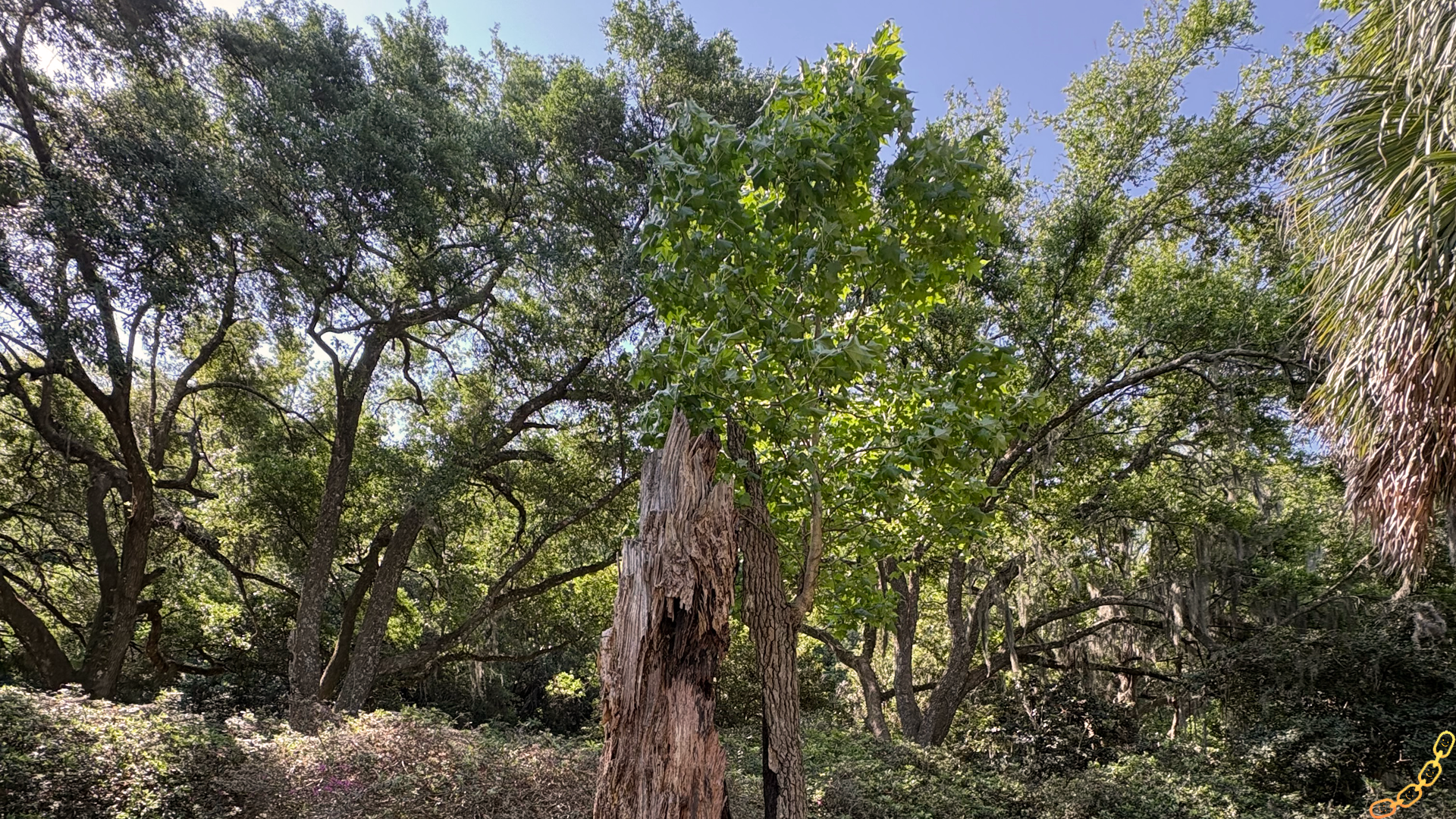
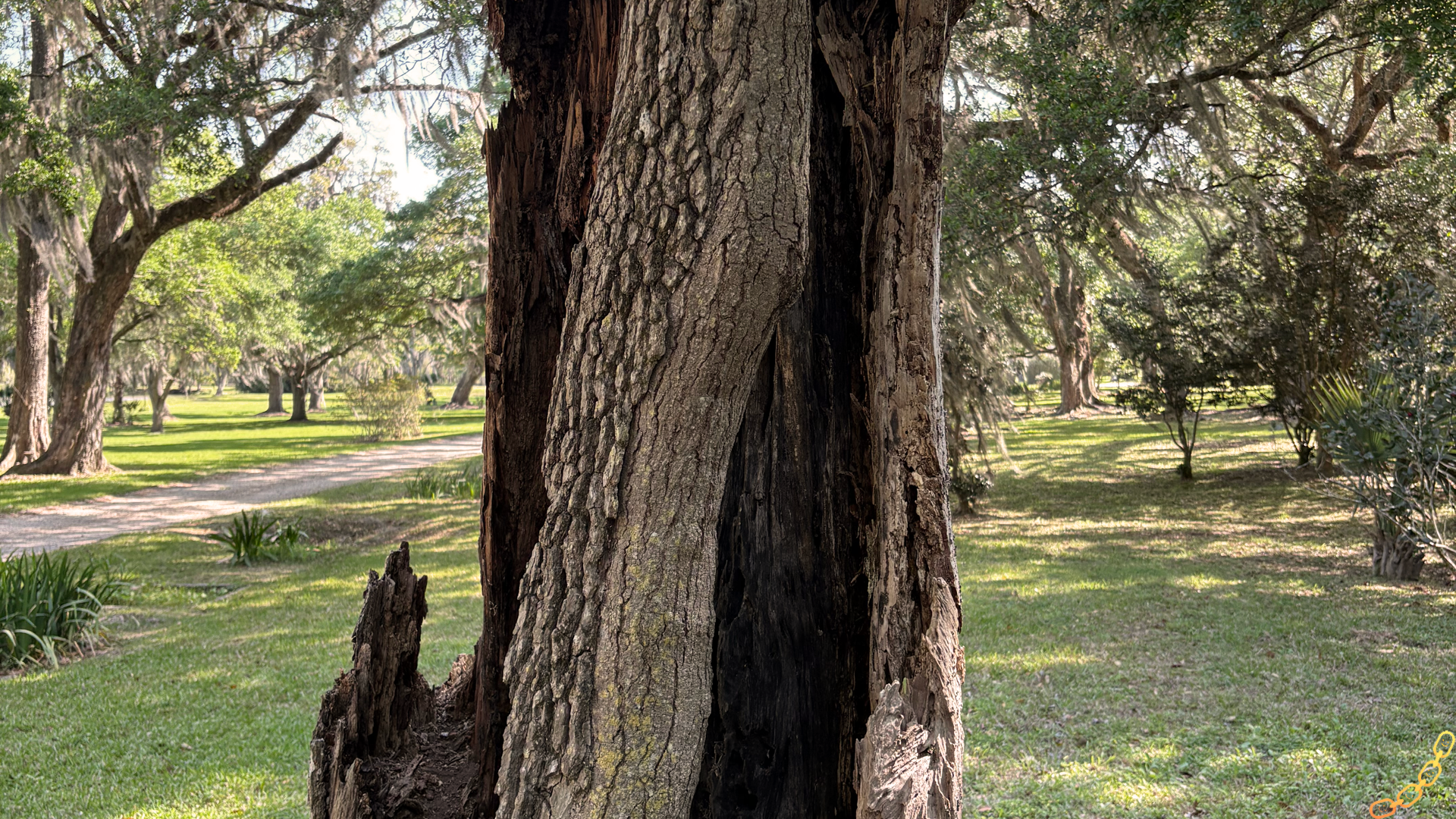
Look closely at this tree in Avery Island, Louisiana. A lightning strike tore through its core, leaving a massive hollow and shattered wood. Yet a narrow sliver of living tissue survived. From that small, resilient connection, vibrant new growth now pushes upward—bright green leaves reaching toward the sky against a clear blue backdrop.
This isn’t a story of perfect recovery. It’s a story of partial survival sparking new life. The tree didn’t need to be whole to keep growing. It only needed one living pathway to redirect its energy and activate its built-in systems.
We were quite surprised when we stumbled upon this tree while walking the trails at Avery Island. At first you are hit by the devastation and wonder "what happened here?!" Then you see that part of the tree survived and is fighting hard to keep going. The raw photo above shows the reality more clearly than any polished slide: damage and vitality side by side. That image captures the heart of today’s message.
We humans often fear future challenges because of a phenomenon called affective forecasting—our tendency to predict how we’ll feel in the future. And we’re frequently wrong in one consistent direction: we overestimate how badly we’ll feel, and for how long.
What Is Affective Forecasting?
Affective forecasting is simply our brain’s best guess about our future emotions. Will this setback leave me devastated for months? Will I ever feel like myself again?
Research shows we tend to overestimate both the intensity and duration of negative emotions. This is known as the impact bias. We picture ourselves permanently broken by a storm, forgetting that we possess powerful adaptive systems that quietly activate when needed.
Psychologists Timothy Wilson and Daniel Gilbert have shown that we often overlook our “psychological immune system”—the collection of mental processes that help us reframe difficulties, find meaning, and return to baseline faster than we expect.
We neglect these built-in coping mechanisms when imagining the future, a bias called immune neglect. This doesn’t mean serious pain is small or easy. It means we often adapt better than fear tells us we will.
One helpful paper explores how these forecasting errors connect to coping strategies: “Coping strategies and immune neglect in affective forecasting” (PMC).
Even more encouraging, a 2020 study found that a positive bias in forecasting future positive emotions (slightly overestimating how good we’ll feel) can actually support resilience and well-being. Optimistic expectations can become self-reinforcing. Read “Biased Affective Forecasting: A Potential Mechanism That Enhances Resilience and Well-Being” here.
Personality also plays a role. People lower in neuroticism and higher in extraversion often make more balanced forecasts that better match their actual experiences. See this study on realistic affective forecasting and personality.
The Tree’s Quiet Lesson for Us
That lightning-struck tree didn’t wait for its trunk to fully heal. A small living sliver remained, and for now, that was enough to support new growth. It may not survive long-term, but that doesn’t make its response any less remarkable. Biological triggers flipped, energy rerouted, and new growth emerged.
We have parallel systems. When life hits hard, our psychological immune system begins its work—often before we even notice. We adapt. We reroute. We discover strengths that were lying dormant, waiting for the right moment.
The key insight isn’t that we’re unbreakable. It’s that we’re far more adaptable than our forecasts suggest. We don’t need to feel completely whole or fully prepared before we begin moving forward. A single living connection—to a value, a memory, a small daily action, or a supportive person—can be enough to start the regrowth. For us, that might look like texting one trusted friend, going outside for three minutes, or returning to one stabilizing routine.
This understanding gives us a practical tool for self-management. Next time you face uncertainty or hardship, try asking:
- Am I overestimating how long or how intensely this will hurt?
- What small, still-living part of me (a strength, habit, relationship, or value) can I lean on right now?
- What tiny action could help activate my own backup systems?
Even a small step can flip the switch from fear to momentum.
A Gentle Invitation
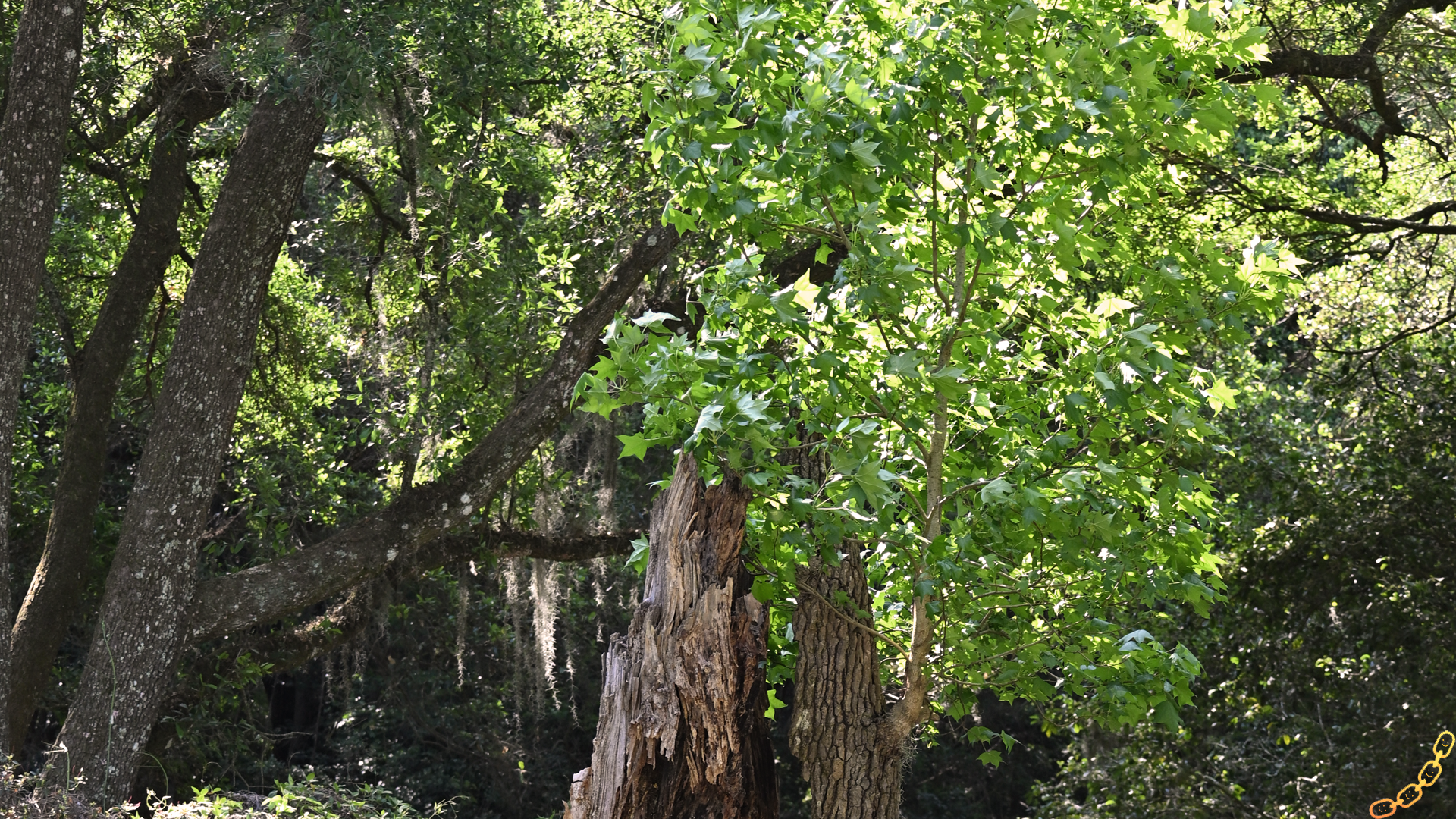
Look again at the photo. See the contrast: the shattered trunk, the surrounding debris, and yet those determined green leaves above. That sliver of life kept going. So can we.
Update: One Month Later
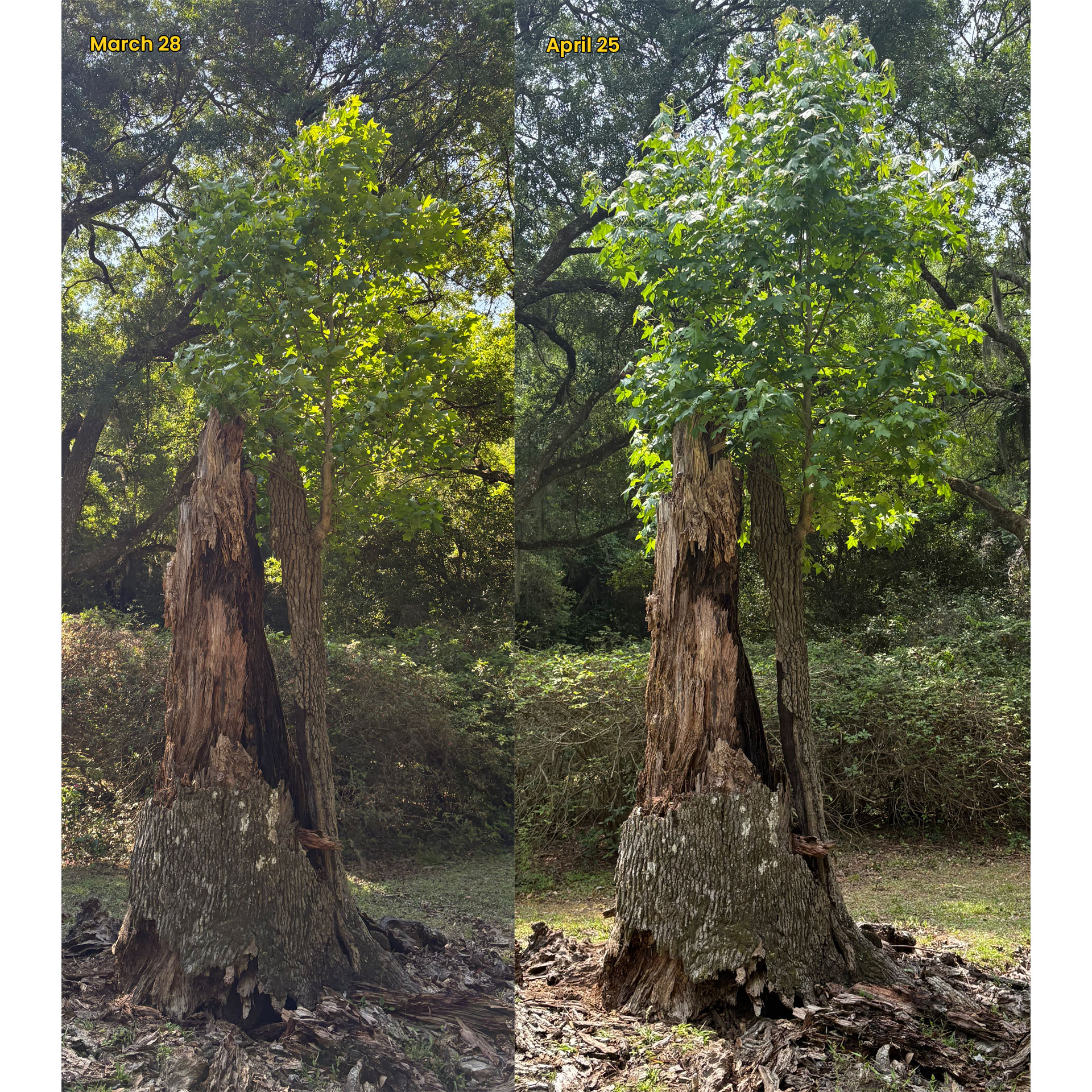
We went back to Avery Island a little less than a month after our first visit to check on the egret colony and see how this tree was doing. The canopy you see in the "After" photo, April 25, has grown so much compared to the "Before", March 28. The new growth isn't just surviving, it's aggressively reaching for light.
We share this update because it perfectly illustrates the blind spot in affective forecasting. When we first saw that narrow sliver of living tissue, we were amazed it was alive at all. We would have underestimated how much growth was possible in just 28 days. We do the same thing to ourselves. We see the damage, gauge the remaining resources, and assume recovery will be slow or limited. Often, our built-in systems are more ambitious than our forecasts allow.